— Second Part — An Inclusive Place That Continues to Embrace Diversity
Transcending a religious framework, Kiyomizu-dera Temple (清水寺) presents to the world a universal form of prayer — Second Part —
The “Inspired by Kyoto” project explores the meaning of Kyoto for the future. Each time we are exposed to the thoughts of practitioners in various fields who are creating Kyoto’s future without being bound by precedent, and we transmit them to the world in the form of narratives.
In first part, Reverend Eigen Onishi (大西英玄師)of Kiyomizu-dera, one of the temples that characterizes Kyoto, discussed how besides playing its role as a historical cultural asset, Kiyomizu-dera fulfills a role of promoting the circulation of goodwill by returning the goodwill it receives from society. He also explained that the temple uses Instagram with the aim of fulfilling the wishes of both visitors and the temple, rather than simply to publicize the temple.
In Second Part, he describes the “FEEL KIYOMIZUDERA” project, which is operated by the temple, and represents a type of inspiration that Kyoto can offer to the world.
The “FEEL KIYOMIZUDERA” Project, Designed to Encourage Contemporary People to Ponder Deeply
“I am pleased that together with my teammates, I was able to start the ‘FEEL KIYOMIZUDERA’ project. We planned the project based on the concept of ‘building another temple on a website.’ I personally believe that it is not appropriate to simply present an image similar to that of the temple, which already exists in the real world. In addition to giving a visual impression, I want to enable viewers to feel the temple with their five senses. Fortunately, all members of the project team shared this recognition since the early stage of the project.”
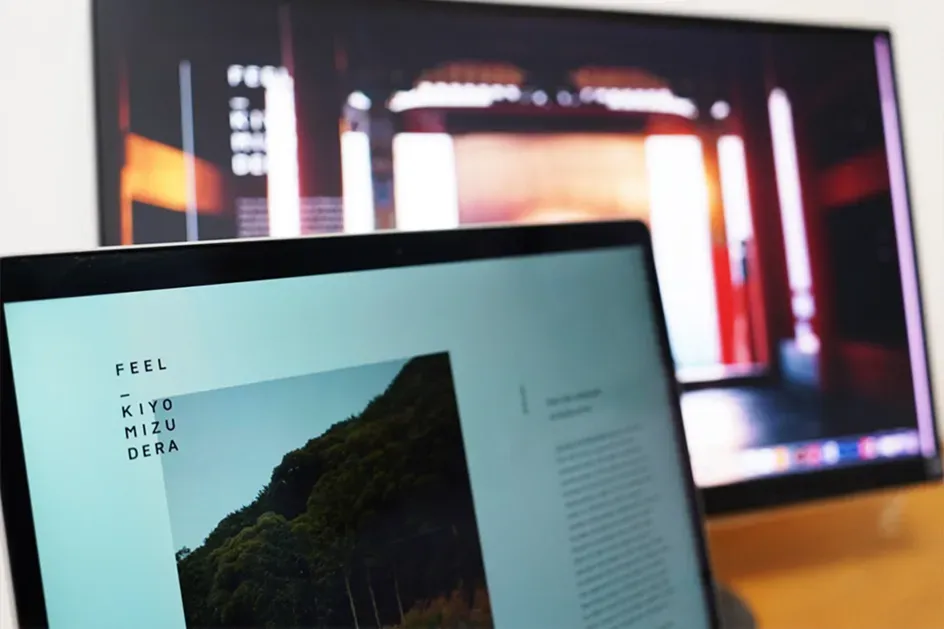
Feel Kiyomizudera on web site
“In the present world, when you have any question, you can immediately find the most likely answer by searching on the Internet. It is certainly beneficial to have ample information available. On the other hand, the ease of gaining information can bring about negative effects, as well. For example, people have become unable to wait for answers, they have stopped thinking, and have lost their power of imagination. Moreover, since none of us want to suffer a loss, we tend to seek only profitable information for ourselves. We also tend to rely on this kind of information to judge the value of our firsthand experiences, be it an encounter with a beautiful landscape or a nice dinner shared with close friends. In many cases, people tend to spend too much time digesting, enumerating, and inputting information. In the contemporary society, this behavior may be necessary to some extent. However, I believe that contemporary people are too sensitive towards something that doesn’t require so much sensitivity, while being too insensitive towards other things for which sufficient sensitivity is necessary. One of the things towards which we should be more sensitive is probably ourselves. In many cases, we cannot see ourselves objectively due to an overload of information. In this context, I believe that in our daily life, we should concentrate more energy on finding out how we feel and what we believe to the extent where we reach self-awareness. Through this process, we can build our own personality and identity, which leads to the discovery of true self.”
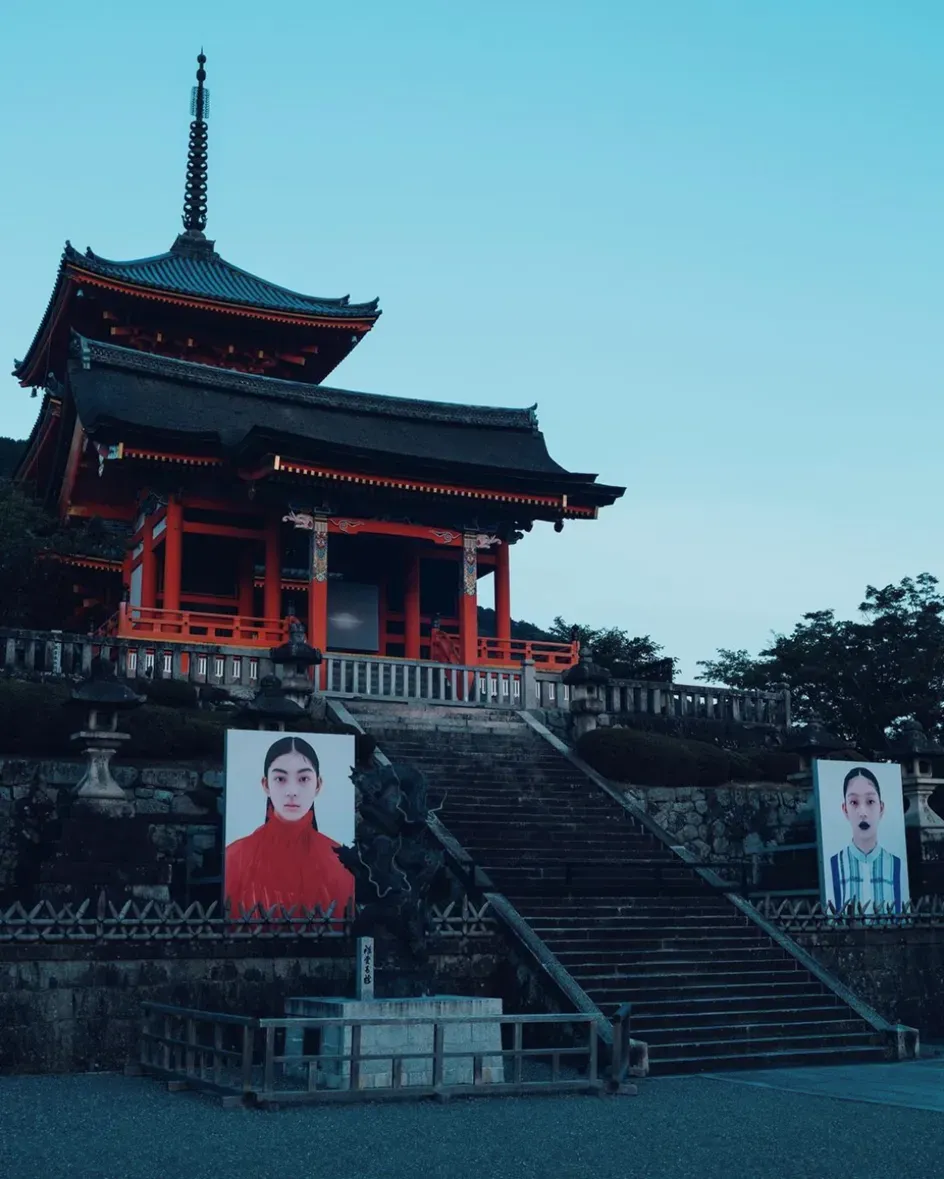
Kensaku Kakimoto Photo Exhibition “TIME” / FEEL KIYOMIZUDERA ©”feel kiyomizudera” on Instagram
“In the ‘FEEL KIYOMIZUDERA’ project, various creators in their respective genres convey their messages on the stage of Kiyomizu-dera. I hope audience will receive their messages freely in their own unique ways.”
I understand that underlying this project, which uses digital technologies, is an aspiration to provide people living today with ideas that are important in contributing to make people cherish each day of their lives.
Kyoto’s Traditions, Comprising the Accumulation of Daily Activities
“At Kiyomizu-dera, we observe an important event known as gokaicho (御開帳) once every 33 years. In this event, we open the door of a small shrine that houses a hidden statue of Buddha. Since the latest event was held in 2000, the next one will be held in 2033. Suppose we have a couple of visitors — mother and her daughter — to the temple today. If I tell them about the next gokaicho and encourage the daughter to take her mother to the temple to attend the event ten years from now, probably she will nearly forget my words over the decade to come. Even so, there can be a few moments when she will happen to flash back to the conversation we have today, and if she takes her mother to worship the hidden statue of Buddha ten years from now, I believe that they will vividly remember the conversations we have today.”

©”feel kiyomizudera” on Instagram
“This story explains what history is. Daily activities of the past and what people felt and thought at each moment are not mere past incidents. People living today repeat the same activities, appreciate their value repeatedly, and pass them on to future generations. Kyoto is a place where people feel history not only as a series of past events but also as a living tradition. For example, if you visit a long-established shop and meet its owner, you will surely feel the weight of history accumulated in the shop. Although this feeling cannot be quantified, and its yardstick can vary from one person to another, I do feel the presence of the weight of history, and this feeling has become increasingly vivid year after year. What I mean is not that we should simply preserve traditions or time-honored cultures. I believe one of the attractive features of Kyoto is that there are people and places that inherit history and traditions in various forms, both tangible and intangible. In other words, visitors to Kyoto can feel historical assets in real time as something alive now, rather than past objects the roles of which were terminated long ago. In this concern, I would like to introduce the following Buddhist phrase: “Doseki taimen gohyakusho (同席対面五百生:lit. sharing a table with someone in 500 lives).” This phrase has double meaning. First, it means it was determined in our previous life (500 lives before the present one) that we share a table with someone today, and so, it is a precious moment to be with that person. The second meaning is that today’s encounter with someone is the starting point for building a good relationship in the 500th life from now. Whenever I look at the people who have a deep sense of gratitude for history and who are devoted to passing on what they have inherited to future generations, I feel they are driven by a power that surpasses human capacity. Indeed, they evoke a sense of awe.”

Wishing Happiness for Others Makes Kyoto a Place Full of Compassion
“At the core of our activities is a prayer for anjin(安心). For this Buddhist term, the same Chinese characters are used as those for a common Japanese term ‘anshin,’ which means relief from anxiety. However, the two terms are slightly different. Although I will not go into detail, Buddhists believe that suffering is an integral part of our daily life that cannot be eliminated. Of course, it is good to work to get rid of sufferings, but we can never be completely free from them. Faith in Buddha does not eradicate sufferings from this world but helps us stay calm even amid a calamity. In English texts, we often hear the following question: ‘When you see a glass containing water to the half-way point, do you see the glass as half-full or half-empty?’ If you are the latter, you will probably worry even when the glass is full of water. Although you may become satisfied at first to see the glass filled with water, gradually, you will begin to think that you have only one glass of water and start worrying. Anjin refers to the state of mind that remains calm and contented no matter whether the glass is half-empty or there is only one glass of water. In our day-to-day life, we encounter worrisome events one after another. Even so, there are so many things in our daily life that can lead us to the state of anjin. In fact, there are more such items than we can imagine. To name a few, we can admire the beautiful moon and breathtaking views of natural settings. I truly hope that you will notice even a few of these signals that will lead you to the state of anjin. If I remember correctly, in a journal that was issued by the Soto sect of Buddhism(曹洞宗), there was a passage as follows: ‘Nature is eloquent to people who are aware of its presence, but it never appears in front of people who are unaware of it.’ At Kiyomizu-dera, we sometimes organize exhibitions for artists. Using the temple as a venue, they display works that show their own interpretation of the temple. It is possible that they sometimes use the temple to promote themselves. However, you don’t have to regard this possibility as overly negative. What is important is that the artists wish anjin for someone else. As long as they embrace this wish, even when they intend to use the temple to promote themselves, we can work together.”
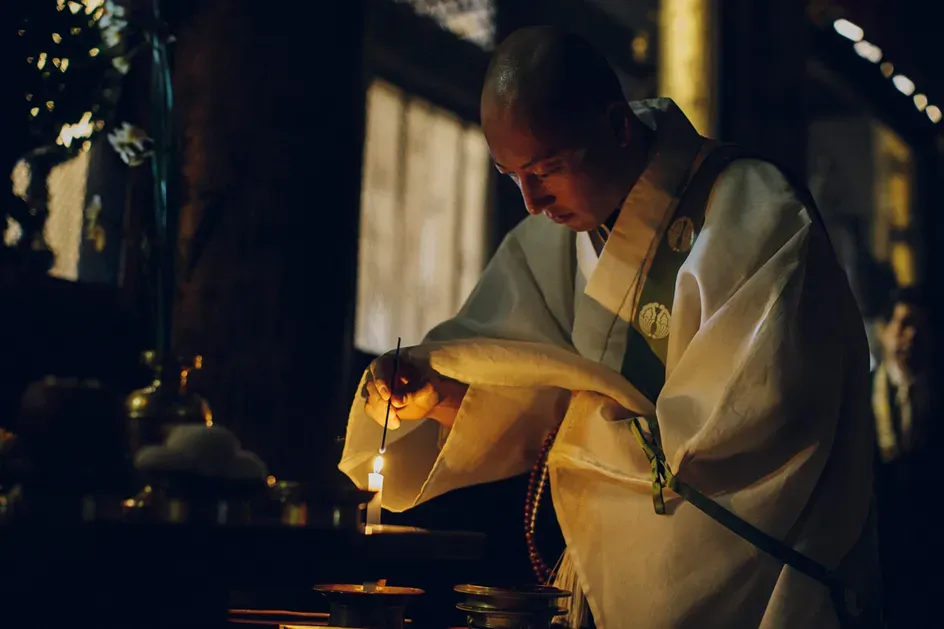
Shushoue ceremony, held in the beginning of the year, to pray for the peace of the world throughout the year ©”feel kiyomizudera” on Instagram
“This, I believe, is applicable to Kyoto in one way or another. To sustain Kyoto for the sake of future generations, it is not necessary to uphold a lofty vision. I believe Kyoto will surely remain an important city desired by society if its residents continue to value and cherish small wishes in day-to-day life, wishes stemming from friendships, love, mutual trust, pride, and so on. If we continue to embrace wishes to cherish people and things, to delight someone else, to protect someone and make them happy, or even wishes to have someone appreciate the delicacy we have made, visitors to the city will surely feel the warm hospitality of Kyoto residents and find their stay in the city inspiring, encouraging, and invigorating.”
Inspired by Kyoto
At the core of activities of Kiyomizu-dera, one of the temples that characterizes Kyoto, is a prayer for anjin for other people. Through the search of Kyoto’s history and tradition, I found that throughout its history, people’s wishes have made the city what it was in each epoch, and that these wishes accumulated over the past centuries characterize Kyoto as it is today. In the present chaotic world, many visitors to Kyoto find their time in this ancient capital to be comfortable beyond expression. Probably this is because they feel the warmth of its residents’ wishes for visitors’ happiness.
In the minds of visitors from around the world, Kyoto can evoke a sense of compassion, which all people have by nature. This change may not be outstanding, but is something that occurs in a subtle way in people’s psyche. Even so, this could be the basis for Kyoto’s presence and for its continuing value into the future.
Text by Yasuhito Sasaki
Onishi Eigen
Sub steward of Kiyomizu-dera Temple. Born in Kiyomizu, Kyoto, in 1978. He entered the Buddhist priesthood in 1989. After graduating from Kansai University in 2000, he studied in the United States and returned to Kiyomizu-dera Temple to resume his service. Currently, he serves as the head priest of Jojuin Sub-Temple(成就院).
Kiyomizudera temple
Kiyomizu-dera Temple is a temple of the Kita-Hosso sect(北法相宗). After it was opened, it adopted the doctrine of the Hosso sect, one of the six sects of Nara Buddhism. In early modern times, Kiyomizu-dera was a branch temple of Kofuku-ji Temple (興福寺:in Nara Prefecture), the main temple of the Hosso sect.
http://www.kiyomizudera.or.jp/en/
TAGS
Date:
2023/8/25
Kyoto Revitalization Section - City of Kyoto
The Kyoto Revitalization initiative aims to preserve and nurture Kyoto’s landscapes, traditions, and culture—treasures of Japan and of the world—and to pass them on to future generations, while sharing their value with people across Japan and around the globe.